California SB9 · Los Angeles · In effect since Jan 2022
Split your lot.
Build up to 4 units.
SB9 lets an LA single-family homeowner split their lot in two and build up to two units on each — without a public hearing. Here's how it works, who qualifies, and how we get it through LADBS.
-
4
Max units per lot
-
2
Lots from 1 (via split)
-
0
Public hearings
The short version
California's biggest housing law since ADUs.
Senate Bill 9 went into effect January 1, 2022. It lets California homeowners on single-family residential lots do something that used to require a full zoning variance: split the lot in two, and build up to two units on each of the resulting parcels. Up to four units on what used to be a one-home parcel — with the city required to approve it ministerially if the project meets code.
The why
Housing crunch.
California is short ~2.5M homes. SB9 was designed to let existing homeowners add density without rezoning or political fights.
The what
Ministerial approval.
No public hearings, no discretionary review, no neighbor objections. The city checks your plans against code — that's it.
The who
Single-family lots.
Only lots zoned R-1 (or equivalent single-family) qualify. Multi-family and commercial zones already have their own paths.
Not every lot qualifies
The baseline rules for SB9 eligibility.
SB9 is generous, but it's not unlimited. Before we design anything, we confirm your property clears these gates. If it does, we move to site planning.
-
Single-family zone
Lot must be zoned for a single-family residence. Condos, duplexes in multi-family zones, and commercial parcels aren't eligible.
-
No protected overlay
Historic district, coastal zone, high-fire-severity zone, protected wildlife habitat, earthquake fault zone, or flood zone → ineligible.
-
Ownership & tenancy
Lot splits require 3+ years of ownership. No tenants evicted in the last 3 years for redevelopment. Renter-occupied homes under 3 years of tenancy → can't use SB9.
-
Lot size sufficient
The parcel must be large enough to fit the existing unit PLUS whatever you're adding, honoring setbacks + open space requirements.
-
Owner-occupancy affidavit
On lot splits, the owner must sign an affidavit committing to occupy one of the units for 3 years after the split.
How we get it approved
Five steps from your lot to your permit.
-
01
Check site eligibility
Confirm your property meets SB9's baseline: single-family residential zone, not in a historic district / high-fire zone / flood zone / other protected zone, 3+ years of ownership for lot splits, no recent evictions.
-
02
Call our planning team
A 15-minute call walks through your goals — unit addition, lot split, or full 4-unit build. We confirm SB9 feasibility and outline timeline + likely cost.
-
03
Free on-site evaluation
A senior planner visits the property: measures, photographs, studies lot constraints, and sketches realistic development options specific to your parcel.
-
04
SB9 application filed
We draw up a formal SB9 project plan (site plan + floor plans), align with setbacks / unit-size / parking rules, and submit to LADBS as a ministerial application — no public hearings, no discretionary review.
-
05
Plan review & permit
LADBS + Planning Department review for code compliance. If they request corrections we handle them. On approval: permits issued and you're cleared to build.
The unlock
Zoning in your way? Get a waiver.
SB9 has a quiet superpower: when local zoning rules — setbacks, parking, lot coverage, lot-width minimums — physically prevent you from adding units or splitting the lot, the city is required to grant a waiver. That means many lots that look "too small" or "too tight" under standard zoning are actually SB9-buildable.
Waivers don't override environmental protection or historic designation — but they do override most local friction. If your lot failed a quick setback check, don't give up.
Check my lot's waiver potential →Waivers typically cover
- ✓Side-yard setbacks
- ✓Rear-yard setbacks
- ✓Lot coverage maximums
- ✓Minimum lot width requirements
- ✓Parking minimums in most cases
Cities must approve a waiver when a zoning rule would physically prevent SB9 rights from being exercised.
Visual example
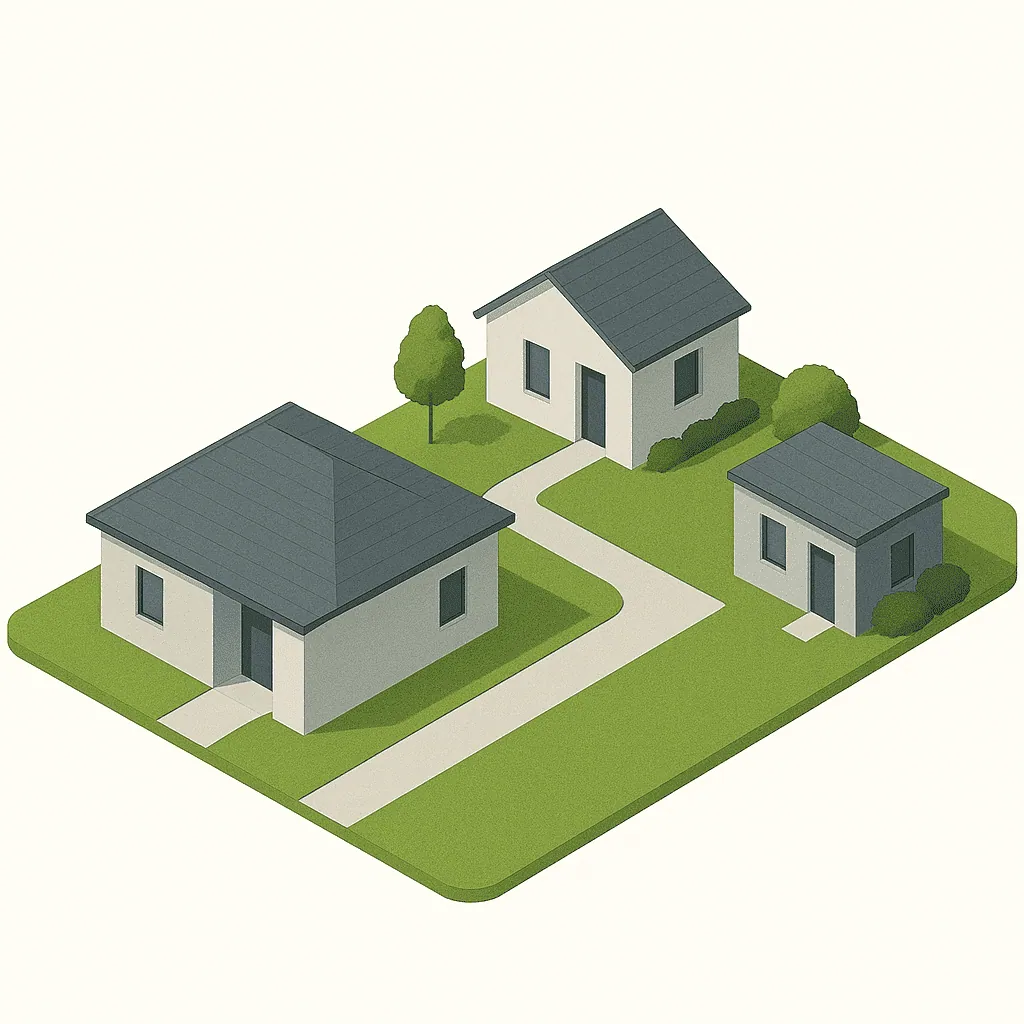
A typical 3-unit SB9 layout on an LA lot.
Main home stays. We add a detached unit plus an attached ADU, then split the lot so two of the three units sit on the new parcel. The result: one lot of record becomes two parcels, each with its own address, utility connections, and sale potential.
Questions
SB9 questions we hear most.
Still have a question? Ask us during your free consultation.
What exactly does SB9 let me do in Los Angeles?
On a single-family lot in LA, SB9 lets you do up to three things: (1) split the lot in two, (2) add a second unit on each resulting lot, and (3) convert or build into a maximum of four total units. All three together is called the 'full 4-unit' path.
Who is NOT eligible?
You're not eligible if your property is in a historic district, high-fire-severity zone, protected wildlife area, or flood zone. You're also not eligible if you evicted tenants in the last 3 years or plan to build on a property tenants have been renting for under 3 years. Lot splits require 3+ years of ownership.
Does SB9 require a public hearing?
No. That's the biggest difference from a conventional lot split or variance. SB9 applications are 'ministerial' — the city reviews for technical code compliance only, not neighborhood opinion. Faster timeline, no neighbor veto.
What if zoning rules (setbacks / parking / lot size) would block my SB9 project?
You likely qualify for a waiver. Cities are required to grant SB9 waivers when standard zoning rules physically prevent you from adding the permitted units or splitting the lot. Waivers don't override environmental protection or historic designation — but they do override most local zoning friction.
What units count under SB9?
Single-family homes, duplexes, and ADUs. You could end up with one home + one ADU on each of the two split lots for 4 total, or a duplex on each lot, or a single new home on each. The combination is yours to pick — subject to lot size.
How long does it take?
Plan design + SB9 application prep: 4–8 weeks. LADBS ministerial review: typically 8–16 weeks when the application is clean. Construction: 6–14 months depending on scope. Total: ~12–24 months from first consultation to move-in.
What's typical cost?
Wildly scope-dependent. A simple detached ADU addition on one half of a split lot might run $180K–$300K. A duplex-on-each-lot 4-unit build is closer to $1M+. Use our /adu-cost-calculator/ for quick sizing, or book a consultation for property-specific numbers.
Free SB9 eligibility check
Find out if your lot qualifies.
15-minute call with a senior planner, then a free on-site evaluation if the lot clears the baseline. No pressure to build with us — just real answers.